Why Houston Black Clay Soil Causes Water Intrusion in Jersey Village
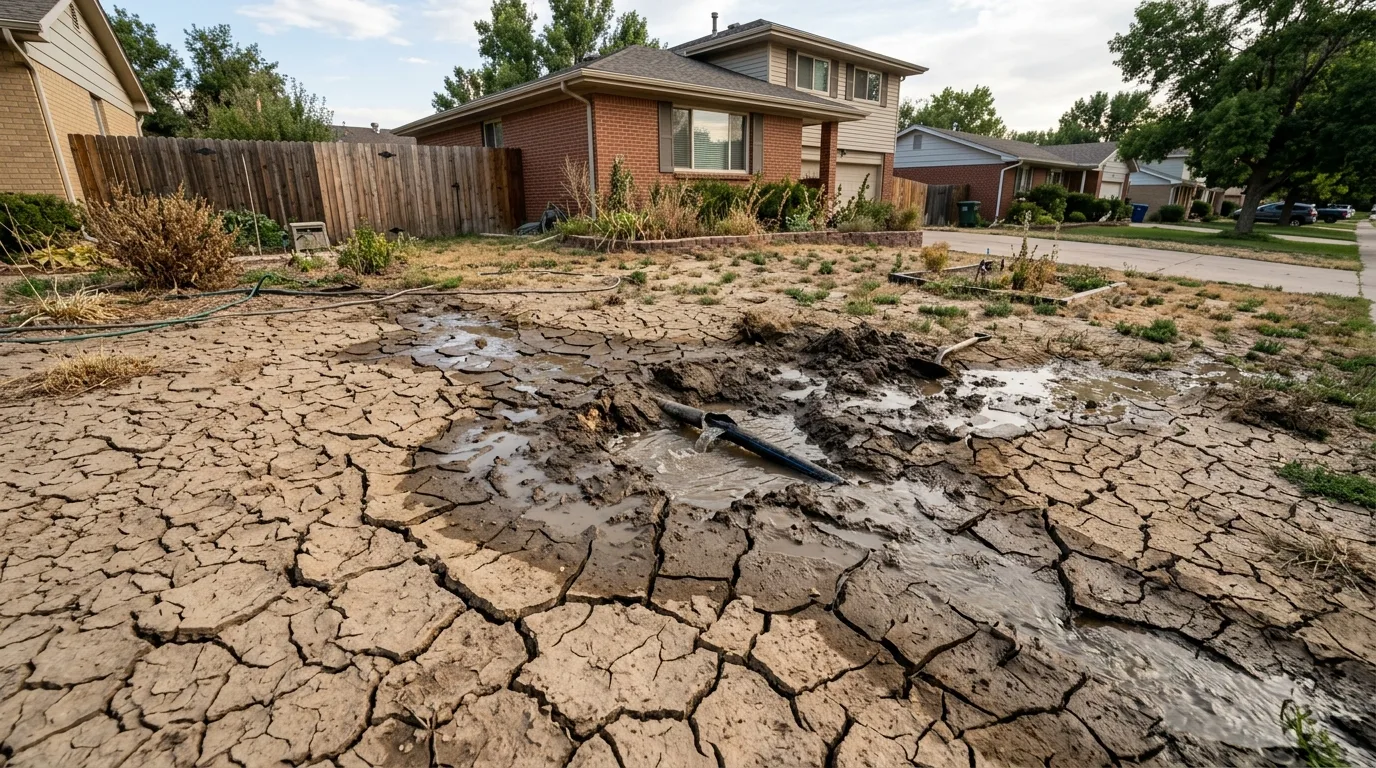
Most Jersey Village homeowners know about the region’s hurricane flood risk. Far fewer understand the soil-driven water intrusion mechanism that operates independently of storm events — one that can introduce moisture into homes during ordinary rainfall, cause foundation movement that creates new water entry pathways, and complicate restoration outcomes for years after an initial water event. Houston Black Clay is the underlying cause, and understanding it is essential for anyone protecting a home in Jersey Village or the broader Harris County area.
In this post, we cover: what Houston Black Clay is and why it behaves differently from other soils, how the shrink-swell cycle creates water intrusion pathways in Jersey Village homes, which neighborhoods and property types are most affected, and what practical steps can reduce soil-driven moisture intrusion.
Water Intrusion in Your Jersey Village Home?
We identify soil-driven moisture entry points as part of every assessment. Call (877) 698-1311.
What Is Houston Black Clay?
Houston Black Clay is a Vertisol soil — a classification defined by its dramatic volume change behavior when its moisture content changes. The active clay mineral in this soil is montmorillonite, which has an unusual crystal structure that allows it to absorb water molecules between its mineral layers, causing the entire clay matrix to expand. Jersey Village’s soil can expand 30% or more in volume when fully saturated compared to its dry-season volume — a dramatic change that has significant consequences for everything built on it.
When the soil is dry — which happens during drought periods and the driest winter months — it contracts equally dramatically, shrinking away from foundation edges and creating gaps. Then, when rain returns, it expands again, creating soil pressure against foundation walls and slabs. This shrink-swell cycle repeats seasonally for decades, creating cumulative stress on everything in contact with the soil: foundation slabs, utility penetrations, exterior walls, and drainage systems.
The greater Houston area — including Jersey Village and all of Harris County — sits on one of the largest Vertisol soil deposits in the United States. The Steeplechase and Eldridge North neighborhoods of Jersey Village sit on Vertisol deposits that have been cycling through this shrink-swell pattern since the foundations of the community’s earliest homes were poured in the 1960s and 1970s.
How Black Clay Creates Water Intrusion Pathways
Foundation slab cracking. The seasonal volume changes in the underlying soil create differential movement in concrete foundation slabs. Sections of the slab that have different moisture exposure — a shaded corner versus a sun-exposed section, or an area near a downspout versus an area far from drainage — expand and contract at different rates. This differential movement creates micro-fractures in slabs that weren’t present at construction. These fractures are typically below the detectable threshold on standard home inspection but can transmit soil moisture upward into living spaces during high-moisture soil conditions.
Utility penetration gaps. Pipes, conduit, and drains that penetrate the foundation slab or exterior walls were installed with tight, sealed openings. As the soil swells and contracts seasonally, the concrete surrounding those penetrations moves while the pipe itself remains relatively static. Over 30–50 years — the age of many Jersey Village homes — this differential movement creates gaps around penetrations that weren’t there at installation. These gaps can transmit both water and soil gases (including radon) into the living space.
Foundation wall separation. In homes with stem wall construction or block foundations rather than monolithic slabs, the seasonal soil movement can open gaps at the joint between the foundation wall and the floor slab. These gaps are particularly problematic because they occur at the floor level, allowing soil moisture and occasionally bulk water to enter at the lowest point of the living space.
Landscape and drainage grade changes. As the soil shrinks during dry periods, it pulls away from the foundation perimeter, creating a depression that subsequently collects surface water and directs it toward the foundation during rain events. Homeowners who maintain proper foundation grading in spring often find the grade has reversed by fall — because the soil contracted during the dry summer months.
Soil-Driven Moisture Intrusion in Jersey Village?
We use thermal imaging to map moisture entry points. Call (877) 698-1311 for a free assessment.
Which Jersey Village Properties Are Most Affected
The impact of Houston Black Clay on a specific property depends on several factors:
Age of the home. Older homes have experienced more shrink-swell cycles and have more cumulative foundation stress. Homes built in the 1960s through 1980s in Jersey Village’s established neighborhoods have had 40–60 years of this cycling. Newer construction in areas developed in the 2000s has had fewer cycles, though the underlying soil is the same.
Tree proximity. Large trees draw significant moisture from the soil through their root systems. Trees close to a foundation cause localized soil drying that contracts soil faster and more severely immediately adjacent to the foundation, creating larger and more dramatic gaps during dry periods. The mature tree canopy in the Jersey Meadow Golf Course area, Clark Henry Park surroundings, and older residential streets is associated with higher rates of soil-related foundation movement than tree-free newer subdivisions.
Drainage quality. Properties with good drainage that channels rainwater away from the foundation maintain more consistent soil moisture around the perimeter — reducing the severity of shrink-swell cycling at the foundation edge. Properties with poor drainage that allows water to pond adjacent to the foundation experience the most dramatic soil volume changes.
Proximity to Jersey Lake and drainage channels. Properties near jersey Lake and the drainage channels that serve the community have higher groundwater table proximity, which affects the rate and extent of soil moisture cycling.
Practical Steps to Reduce Soil-Driven Water Intrusion
Maintain consistent soil moisture around the foundation. During extended dry periods, watering around the foundation perimeter (not the foundation itself) with a soaker hose can reduce the severity of soil contraction and the resulting gap formation. Consistency is more important than volume — the goal is preventing the dramatic dry-wet cycling, not over-saturating the soil.
Inspect and re-caulk penetrations annually. Pipe and conduit penetrations through the slab and foundation walls should be inspected annually and re-caulked with polyurethane exterior sealant wherever gaps have opened. This is an inexpensive annual maintenance step that prevents moisture entry at the most vulnerable points.
Correct foundation grading every fall. Check the grade around your foundation perimeter each fall after summer soil contraction has occurred. Add soil where needed to maintain a consistent positive slope away from the foundation — the standard recommendation is 1/4 inch per foot for the first 6 feet from the foundation.
Consider an interior drainage system. For homes with persistent soil moisture intrusion that cannot be fully addressed through exterior grading and penetration sealing, an interior drainage system with a sump pump provides a managed way to collect and remove soil moisture that enters through the slab — redirecting it before it causes structural damage or supports mold growth.
Frequently Asked Questions
Does Houston Black Clay cause water damage even when it’s not raining?
Yes — when the soil is dry and contracts, it pulls away from foundation penetrations and creates gaps that subsequently admit water when rain returns. The water intrusion event is triggered by rain, but the pathway was created during the preceding dry period. This is why Jersey Village homeowners sometimes experience water intrusion during the first significant rainfall after a dry period rather than during the heaviest storms.
Can foundation repairs address Houston Black Clay water intrusion?
Pier installation and other foundation repair methods stabilize the structural position of the slab but don’t eliminate the underlying soil’s shrink-swell behavior. Water intrusion through foundation cracks and penetration gaps may need to be addressed independently of any structural stabilization work through interior drainage systems, vapor barriers, and penetration sealing.
Is water intrusion from Houston Black Clay covered by homeowners insurance?
Generally no — gradual water intrusion through soil migration is considered a seepage or foundation issue and is excluded from standard homeowner policies. Coverage applies to sudden, accidental water events. Preventing soil-driven intrusion is a property maintenance responsibility. However, if the intrusion caused mold damage that was not discovered promptly and reported, the mold may also be excluded.
Related resources:
- Hidden signs of water damage in Jersey Village homes
- Living in Jersey Village: homeowner’s water damage prevention guide
- Water damage restoration in Jersey Village
Soil-Driven Water Intrusion in Jersey Village — We Can Help
Call (877) 698-1311 for a moisture assessment that identifies soil-driven entry points. Serving Jersey Village and all of Harris County.