Sewage Backup Cleanup Jersey Village: What Homeowners Need to Know
A sewage backup in your Jersey Village home is the most serious water damage event you can experience — not because the water volume is necessarily large, but because category 3 black water contains raw sewage, bacteria, viruses, and other pathogens that pose direct health risks to anyone who enters the affected area without proper protection. This guide gives Jersey Village homeowners the complete picture on what sewage cleanup involves, what it costs, and how to protect your family.
In this post, we cover: what makes sewage backup a health emergency, why Jersey Village sees sewage backups during storm events, the complete cleanup process, insurance coverage, and how to choose a qualified contractor.
Sewage Backup in Jersey Village? This Is a Health Emergency
Do not enter the affected area. Call (877) 698-1311 immediately for professional response.
Why Sewage Backup Is Different from Other Water Damage
Sewage backup is classified as category 3 black water — the most severe contamination category in water damage restoration. The distinction matters because the cleanup protocol is fundamentally different from clean water events. While clean water spills can sometimes be dried in place if addressed within hours, sewage-contaminated materials cannot be made safe by drying. Every porous material that has contacted sewage — drywall, insulation, carpet, padding, and often hardwood flooring — must be removed and disposed of as biohazard waste regardless of whether it appears wet.
The pathogens present in sewage — including E. coli, hepatitis A, Cryptosporidium, and multiple bacterial and viral species — can remain viable on porous surfaces for days to weeks after the visible sewage has been removed. This is why surface wiping is insufficient: the contamination lives within the material, not just on its surface. Only complete material removal followed by EPA-registered disinfection of all remaining hard surfaces achieves the decontamination standard that makes the space safe for occupancy.
Why Jersey Village Sees Storm-Related Sewage Backups
Jersey Village’s municipal sewer system, like most of Harris County’s sanitary sewer infrastructure, experiences inflow and infiltration during major storm events — a phenomenon where stormwater enters the sanitary sewer system through cracked pipes, manhole covers, and improper connections. When sanitary sewers surcharge beyond their design capacity, they discharge back through the lowest fixtures in buildings served by the system: floor drains, bathtubs, and toilets in lower levels.
This storm-driven surcharge is distinct from typical sewer blockages and happens across entire neighborhoods simultaneously — which is why sewage backup calls spike during and immediately after major rain events throughout the Fairbanks area and the Eldridge North neighborhood. The same storm that causes basement flooding can simultaneously cause sewage backup through lower-level fixtures, combining category 3 floodwater with active sewage discharge in a single event.
The flat topography and clay soils that make Jersey Village susceptible to flooding also slow drainage of storm water from sewer catchment areas, extending the duration of sewer surcharge events and increasing the quantity of sewage that backs up through building drains during major storms.
The Sewage Cleanup Process: What Actually Happens
Immediate response: Do not enter the affected area without respiratory protection and waterproof gloves. Do not use any sinks, toilets, or drains connected to the affected drainage system until the backup source is cleared. Call for professional response and leave the affected area until the crew arrives.
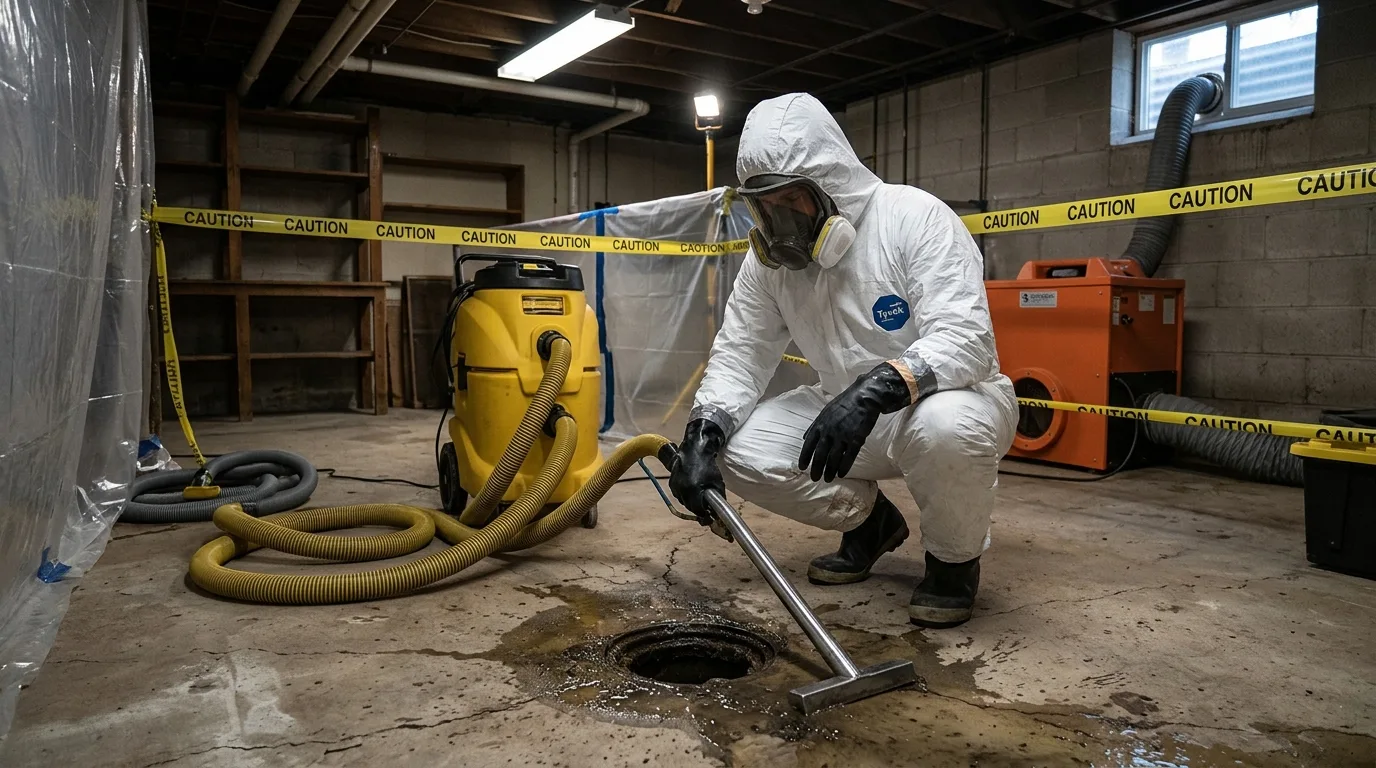
Crew preparation: Our team arrives in full PPE — Tyvek suits, N-95 or P100 respirators, waterproof boots, and nitrile gloves. Category 3 cleanup cannot be conducted without proper respiratory protection due to airborne pathogen risk from disturbing sewage.
Sewage extraction: Truck-mounted units with containment for biohazard waste remove liquid sewage as rapidly as possible. This is not a shop vacuum operation — the waste must be contained and disposed of in compliance with Texas Commission on Environmental Quality regulations.
Demolition and disposal: All porous materials below the sewage line are removed and double-bagged in heavy-duty biohazard waste bags for disposal. This includes drywall, insulation, carpet, pad, and baseboard. No exceptions — even materials that appear to have had minimal contact must be removed because pathogen migration through wall cavities is not visible to the eye.
EPA-registered disinfection: All remaining hard surfaces — concrete, tile, studs, metal — are scrubbed, HEPA-vacuumed, and treated with EPA-registered disinfectants effective against the specific pathogens present in sewage. This step is applied multiple times with appropriate dwell time for effective disinfection.
Structural drying: Air movers and dehumidifiers begin the structural drying phase after disinfection is complete. Moisture remaining in structural assemblies after sewage cleanup provides conditions for mold colonization — which in Jersey Village’s year-round humidity can establish on even decontaminated framing if moisture remains.
Clearance and reconstruction: After verified drying, we rebuild the affected area with new drywall, insulation, flooring, and finishes.
Sewage Backup Cleanup — Professional Response in Jersey Village
Call (877) 698-1311 immediately. We respond 24/7 throughout Harris County.
Types of Sewage Backup Events
Main sewer line backup: All drains in the home backup simultaneously, indicating a blockage in the main lateral or the municipal main. Requires plumber to clear the blockage before restoration can proceed.
Floor drain backup: Ground-level floor drains overflow during heavy rainfall as storm water enters the sanitary sewer system, causing sewer line surcharge. Affects lowest-level drains while upper-level drains may still function.
Toilet backup: Individual toilet drain blockage causing overflow at the fixture. Typically localized unless the main line is also blocked.
Sewer lateral failure: A cracked or collapsed lateral line allows sewage to exfiltrate into the soil adjacent to the foundation and can re-enter the home through the slab or through water table pressure.
Insurance Coverage for Sewage Backup in Jersey Village
The optional sewage backup rider is the most commonly overlooked coverage gap in Texas homeowner insurance. Many Jersey Village homeowners discover after a sewage backup event that their standard homeowner policy explicitly excludes sewage damage — and that the sewage backup rider they didn’t purchase would have covered the full cost of cleanup and reconstruction.
If you have the sewage backup rider, coverage typically includes professional cleanup, material removal, reconstruction, and content replacement up to the rider’s limits. We assist with all insurance documentation from the first assessment call.
Frequently Asked Questions
Can I clean up a sewage backup myself in Jersey Village?
No — sewage backup is a biohazard that requires professional response with appropriate PPE and equipment. Category 3 black water contains pathogens that pose serious health risks. Attempting cleanup without proper respiratory protection can result in serious illness. Vacate the affected area and call for professional response immediately.
How much does sewage backup cleanup cost in Jersey Village?
Typically $2,000–$10,000 depending on volume and scope. Category 3 mitigation runs $7–$12/sq ft; reconstruction averages $20–$37/sq ft across Harris County. Homeowners with the sewage backup rider typically find most costs covered subject to policy limits and deductible.
How long does sewage backup cleanup take in Jersey Village?
Initial cleanup (extraction, demolition, disinfection) takes 1–3 days. Structural drying follows for 3–5 days. Reconstruction adds 1–3 weeks depending on scope. Total project time is typically 2–5 weeks from first response to completed rebuild.
Related resources:
- Sewage backup cleanup in Jersey Village
- Water damage restoration in Jersey Village
- Does homeowners insurance cover water damage in Texas?
Sewage Emergency in Jersey Village — Call Immediately
Jersey Village Water Damage Restoration provides 24/7 sewage backup response. Call (877) 698-1311. Serving Jersey Village and all of Harris County.